"Nuts and bolts": interactive exibits

Exhibit development & fabrication

Designs & performance specifications

Discovery Disks: mobile mini-interactives

'Beam Cam' projecting video microscope

Underwater Street Discovery Centre

Moscow Planetarium

Sellafield Visitor Centre

'Alternative energy'

Earth Science

Fixed Discovery Disks, Glasgow

Air-table, telescope, moon-phases

Astronomy exhibits for Valencia

Biometrics

Magnetic field exhibit for CERN, Geneva

Tabletop Discovery Disks: magnetism

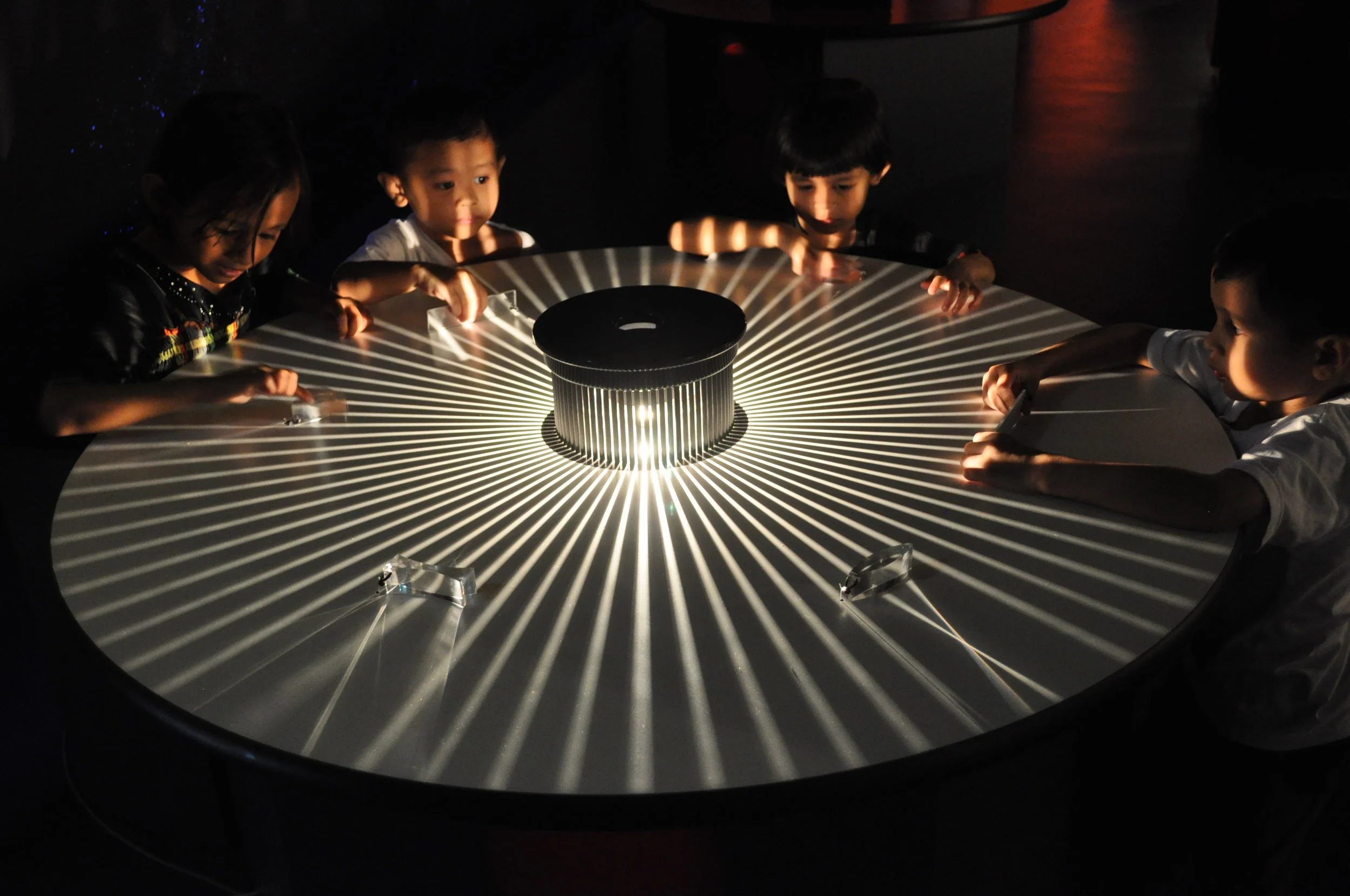
Tabletop Discovery Disks: Light

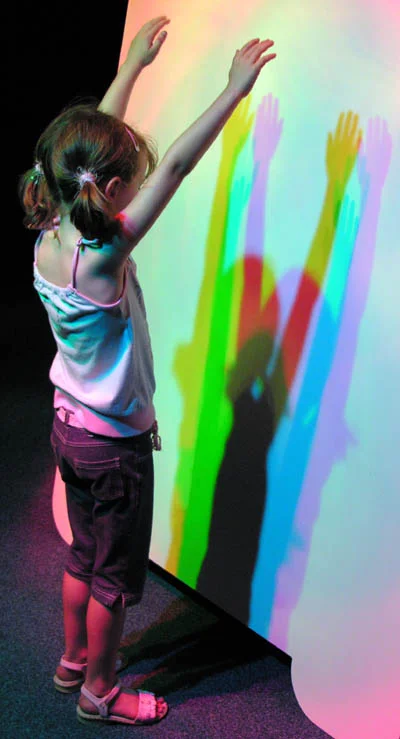
More Light interactives

"Academic" interactives: The Energy Enzyme

"Academic interactives": Electron beams

"Academic interactives": Mantle geology

Working canal-lock model

Virtual exhibit: Ich bin einmalig

Chemistry interactives: Chirality

Video microscopes: Melting crystal

Push-button quiz: Breath of life

Environmental & biological

Cookbook outlines of my 1992 "classical" Great Explorations interactives

Talk to me!

UK phone/fax
+44 (0) 1663 743794

Email ian@interactives.co.uk


Environmental and biological

Most hands-on science exhibitions include very little about wildlife, biology or environmental subjects. To correct this imbalance, we have been developing numerous ways of presenting these popular subjects interactively.

Here, you really feel as if you are walking through a wood. The trees are represented photographically and recorded birdsong plays continuously from speakers in the hanging fabric "foliage". A moving, dappled sunlight effect is projected onto the floor. At a low level, "feely-holes" contain invisible animal models which must be identified by touch alone. A cute, strokable, indestructible fox keeps watch.

Urban wildlife is represented here. There are more feely-holes in the "hedge", with a photographic mural behind, showing the fronts of houses. Extremely robust flip-ups reveal further surprises on the brick wall.

The important thing in designing an exhibition like this is to maintain a constant sense of surprise and exploration. You never know what is around the next corner. And there are plenty of corners.

Another cute, strokable, fibreglass model. "A grey seal can hold its breath for fifteen minutes : how long can you hold yours?" There is a simple timer on the wall. We understand that no child has actually passed out while trying to beat the seal, so far.

"That's life, isn't it? Just sand, and mud." Against a twinkling fibre-optic background, the recorded voice of a professional lugworm impersonator sadly explains this estuarine worm's monotonous, mud-swallowing lifestyle to the child on the left. The source of the sound periodically appears to move across from one end of the burrow to the other as the worm reverses up to the surface to add to its squiggly "cast". The child in the centre has just crawled through a short tunnel with its own squelchy sound effects.

Those recorded-commentary headphone sets you often see in exhibitions always seem to be broken, don't they? In line with my minimum-maintenance policy, I have a much better system. And remember, having a button to press does not necessarily mean true interactivity. People must always feel free to walk away. There should be plenty of choices, with each recording only a few seconds long.

We have helped the Royal Society for the Protection of Birds add a hands-on dimension to many different projects, such as this interactive graphic panel, one of six, in an observation 'hide' at Lochwinnoch. Here you see push-button sound effects, a multiple-choice electronic quiz, and a 'feely-hole', carefully integrated within a panel designed to interprete the environment outside the window. Sensitive, innovative use of specially produced solid-state sound-store circuits can be especially useful for biological and environmental exhibitions.

A sliding magnifier focuses this visitor's attention on some live shrimps. There are many ways of displaying live specimens interactively in aquaria etc. Another example is the "steerable spotlight" we developed recently.

It's always important to find ways of developing empathy between visitor and subject. This man is about to see the world through the eyes of a curlew, which has them at the sides of its head like most other birds. An arrangement of mirrors and lenses inside the model produce the effect.

Fundamental concepts can be communicated to all ages. These sea creatures can be moved and stuck anywhere in the picture. The text panel, at adult height, asks, 'Which creatures live on the bottom?' ', Which creatures swim in the water?' 'Do fish like swimming with the same kinds of fish?' 'Do some big fish chase and eat smaller fish?' This is designed to encourage fruitful conversations between children and accompanying adults.

Our native British basking shark typically grows over 8 metres (27 feet) long. That's huge: far bigger than the exaggerated rubber model used in the Jaws films! The method chosen to communicate such dimensions was to display some of our common local sea monsters at their actual size. This exhibit makes everybody gasp.

Weatherproof outdoor graphics panels don't always have to be expensive.

Also in front of Exploris, the Northern Ireland Aquarium, how about a 3 metres tall sperm whale tail plunging into the ground?

I also designed the logo for this 1997 temporary exhibition.

We find touch-screen computers useful and reliable for all kinds of roles, but avoid the common mistake of presenting people with more information than they want or need. Displays are simple, enticing and user-friendly. An on-screen encyclopaedia is seldom desirable.

Grab the fishing line and pull up a glow-in-the-dark sea serpent!